
A keyboard group buy is a paid pre-order where you pay first, production starts later, and delivery can take months or even more than a year.
If I had to sum it up fast, here’s what matters most:
- You pay before the item is made
- The project usually needs an MOQ to move into production
- Interest checks happen first so buyers can give feedback
- Wait times are long and delays are common
- Refund options are often limited after the sale closes
- The upside is access to small-run keyboard parts you may never see in regular stores
This model exists because custom keyboards, keycaps, and parts are sold in small batches. A vendor uses buyer funds to cover production, which helps meet the factory’s minimum unit count. No MOQ usually means no run.
For me, the simple way to look at it is this: group buys trade speed and buyer protection for access to niche products. If you want a board, case, or keycap set now, in-stock is usually the safer path. If you’re okay waiting 6 to 12+ months, and you trust the vendor, a group buy can make sense.
Should you do keyboard GROUP BUYS?
sbb-itb-3cb9615
Quick Comparison
| Option | When you pay | Wait time | Risk level | Refunds | Best for |
|---|---|---|---|---|---|
| Group Buy | Before production | Months to 1+ year | Higher | Often limited after close | Small-run, hard-to-find designs |
| In-Stock | After product is made | Days to weeks | Lower | Normal store policy in many cases | Buyers who want speed and less risk |
Bottom line: if you join a group buy, you’re not buying a finished product off a shelf. You’re helping fund a production run and waiting for it to happen.
How a group buy works
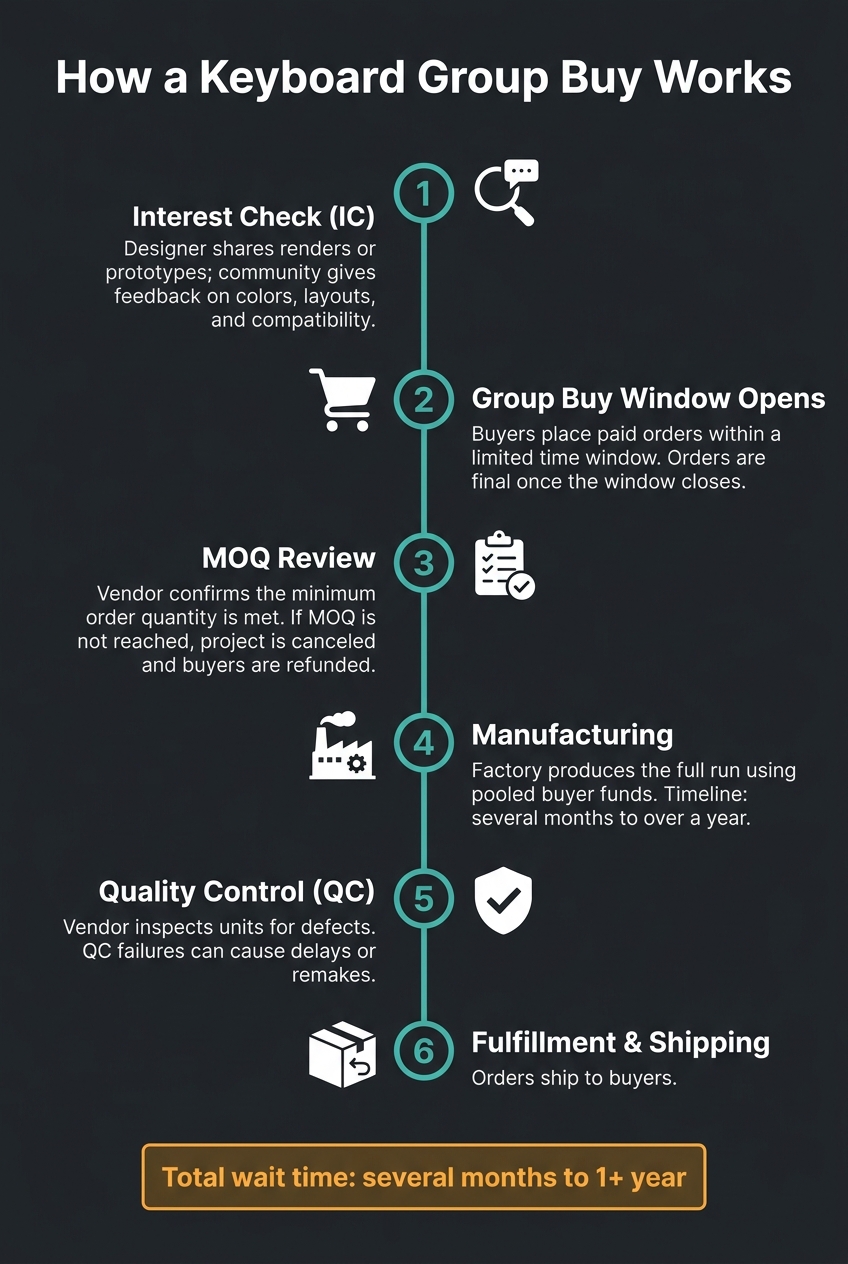
How a Keyboard Group Buy Works: Step-by-Step Timeline
When a group buy opens, the process is pretty simple. Buyers place paid orders for a product that may only exist as renders or early prototypes. Those orders make it possible to turn a niche idea into a production run. The order window is limited, and once it closes, orders are final.
Before the buy opens, designers often run an interest check to see if people want the product and to fine-tune the design.
The typical group buy timeline
The timeline usually follows the same path, even if each phase takes a different amount of time.
| Phase | What happens |
|---|---|
| Interest Check (IC) | Designer shares renders or prototypes to gauge demand |
| Group Buy window | Buyers place paid orders |
| MOQ review | Vendor confirms the minimum is met |
| Manufacturing | Factory produces the run |
| Quality Control (QC) | Vendor checks for defects |
| Fulfillment | Orders ship to buyers |
What MOQ and interest checks mean
MOQ is the minimum number of units needed to start production. If orders don’t reach that number by the time the window closes, the project is usually canceled and buyers get a refund.
The Interest Check (IC) happens before any money changes hands. A designer shares renders or early prototypes so the community can weigh in on colors, layouts, and compatibility. That feedback helps shape the final product before the group buy opens.
That setup is also a big reason many keyboard enthusiasts go for group buys.
Why keyboard enthusiasts join group buys
Keyboard enthusiasts join group buys to get designs that big retailers almost never carry. Think custom aluminum cases, flex-cut PCBs, less common layouts, and themed keycap sets. In many cases, these projects only happen if enough people in the community want them.
Access to custom and limited-run designs
Group buys give people access to products shaped around enthusiast tastes, not broad retail demand. That usually means more niche layouts, more design personality, and parts made for a specific crowd instead of everyone at once.
Limited runs also add to the appeal. These items can feel more special, and they may be much harder to find later. Price matters too. In some cases, group buy pricing is lower than the price you might see if the product reaches retail later.
Community involvement and pooled funding
Interest checks give buyers a chance to help shape the final product before sales begin. Designers ask for feedback on colors, layouts, and features, and that feedback can have a direct effect on the end result.
There’s also a simple money side to it: pooled funding helps make small-batch production possible. Without enough buyers up front, many of these projects wouldn’t get off the ground. Unlike in-stock products, group buys give up speed in exchange for exclusivity.
That appeal comes with a tradeoff: longer waits and less certainty.
The main risks and tradeoffs of group buys
The upside is easy to see. But the downside is just as real.
When you join a group buy, you are paying now for a product that does not yet exist. Your money helps fund manufacturing, so your payment is locked in before a single unit is made. That’s a very different deal from buying something that’s already sitting on a shelf.
Lead times can drag on for months, and sometimes for more than a year. Even when a project starts off on track, production can slip because of QC problems, factory backlog, or customs clearance. Product specs can shift too, especially when the buy opens before physical prototypes are finished. In less common cases, a vendor or proxy can hit money problems, which can leave buyers without the item or a refund.
"A group buy is a form of preorder that wants to offer fewer consumer protections, yet presents more risk." - Thomas Baart, Founder, splitkb.com
Refunds are one of the biggest tradeoffs. After the order window closes and funds go into production, most group buys become non-refundable and non-cancellable. On top of that, payment provider dispute windows often run only 6 to 12 months from the payment date, so that protection may run out before a delayed order ships. And if the minimum order quantity (MOQ) is not reached, the project may be canceled and refunded.
| Benefits of Joining a Group Buy | Risks or Tradeoffs |
|---|---|
| Access to niche or limited-run products | Long wait times before delivery |
| Support for original community designs | Delays in manufacturing or shipping |
| Direct input during the interest check phase | Product details may change before production |
| Opportunity to buy custom mechanical keyboards not offered in-stock | Refunds may be limited after the order window closes |
| Collectible or exclusive appeal | Quality issues or project cancellation can happen |
Delays, changes, and refund limits
Production delays usually come from a few familiar trouble spots: QC failures that force remakes, factory backlog, and customs clearance. When more than one of those hits at once, a project can slip far past the original timeline.
Product details can change during production too. If physical prototypes were not locked in before the buy opened, the final color or finish may end up looking a bit different from the first renders. That usually comes down to manufacturing limits, not an effort to fool buyers.
Refund rules depend on the vendor, but the pattern is pretty consistent: once the buy closes, your options narrow fast. Reading the refund policy before you pay is one of the smartest moves you can make.
How to decide if a group buy is right for you
A simple filter works well here: do you need this item soon? If the answer is yes, a group buy is probably a bad fit. These projects make more sense for people who are happy to wait and care a lot about a specific design, not for someone who needs a keyboard in the next few weeks.
The vendor also matters a lot. Before you buy, look for:
- A track record of finished projects
- Photos of real physical prototypes, not just renders
- Frequent updates on Discord or forums
If there’s a long list of buyer questions with no replies, that’s a red flag.
Group buys vs. in-stock options: which is right for you
Once you know the basics, the choice usually comes down to three things: price, speed, and risk.
Group buys can save you money, but you’ll need patience. In-stock options cost more, but they usually get to you much faster. That’s the trade-off in plain English.
Here’s the simplest side-by-side comparison.
| Group Buy | In-Stock | |
|---|---|---|
| Price | May cost about 20% less than in-stock prices | Full retail price |
| Wait time | Several months to over a year | Fast |
| Refunds | Usually non-cancellable and non-refundable after close | Standard retail return policies typically apply |
| Risk | Higher; production is not finished yet | Lower; the product already exists |
| Design availability | Niche, limited-run, highly custom designs | Available now |
When in-stock or second-hand may be a better fit
If you're new to the hobby or you're on a short timeline, in-stock mechanical keyboards are usually the safer bet. You know the item exists, shipping is faster, and the buying process tends to feel much more like normal online shopping.
Group buys make more sense when you've done your homework, trust the vendor, and want a design you can't get any other way.
FAQs
Are group buys worth the risk?
It comes down to your priorities and how much risk you’re willing to take.
Group buys can give you access to exclusive designs at prices that are often lower than retail. That’s the upside. The trade-off is time: many group buys take 6 to 12 months or longer before the product ships.
You’re also paying for something that hasn’t been made yet. So the risks are pretty clear: delays, quality problems, or even cancellation.
If you want to lower the chance of a bad experience, look into the vendor’s track record before you join. Check past group buys, see how they handled delays, and only move forward if you’re okay with the wait and the uncertainty.
How can I tell if a group buy is trustworthy?
Do your homework first. You're paying upfront for items that may take six to twelve months to make, so it pays to be careful.
Look for vendors with a solid track record of past projects and an active social media presence. That can give you a better sense of how they communicate, how they handle delays, and whether they’ve delivered before.
Read the project page closely. If anything feels vague, ask direct questions about logistics, pricing, and shipping. Then trust your judgment.
Group buys always come with risk, including delays or cancellations.
What happens if a group buy is canceled?
If a group buy doesn't hit its minimum order quantity, it's usually canceled and participants get a refund.
Sometimes, the vendor steps in and covers the gap so production can still move forward. In that case, the unsold units are often sold later as extras.
Group buys are generally non-refundable and non-cancelable. But that rule doesn't apply when the minimum order quantity isn't met.