
7 Tips for Joining Keyboard Group Buys
[ Back to Mechanical Keyboards 101 ]Group buys are a way to pre-order custom keyboard parts or accessories at lower prices by pooling funds with other enthusiasts. However, these come with risks like long wait times, upfront payments, and potential delays. Here’s how you can navigate group buys successfully:
- Research the organizer and vendor: Check their reputation, past projects, and communication practices.
- Understand timelines: Group buys involve multiple phases, from interest checks to fulfillment, often lasting months or longer.
- Budget carefully: Account for shipping, taxes, and optional add-ons to avoid unexpected costs.
- Choose secure payment methods: Work with trusted proxies and verify payment security.
- Look for in-stock options: If you don’t want to wait, check for ready-to-ship alternatives.
- Prepare tools and parts: Gather everything you need for assembly while waiting for your kit.
- Plan for delays: Expect timelines to shift and stay updated through vendor communication channels.
Joining a group buy can be rewarding, but it requires patience, preparation, and careful planning to avoid pitfalls.
Keyboard Group Buy Timeline: From Interest Check to Delivery
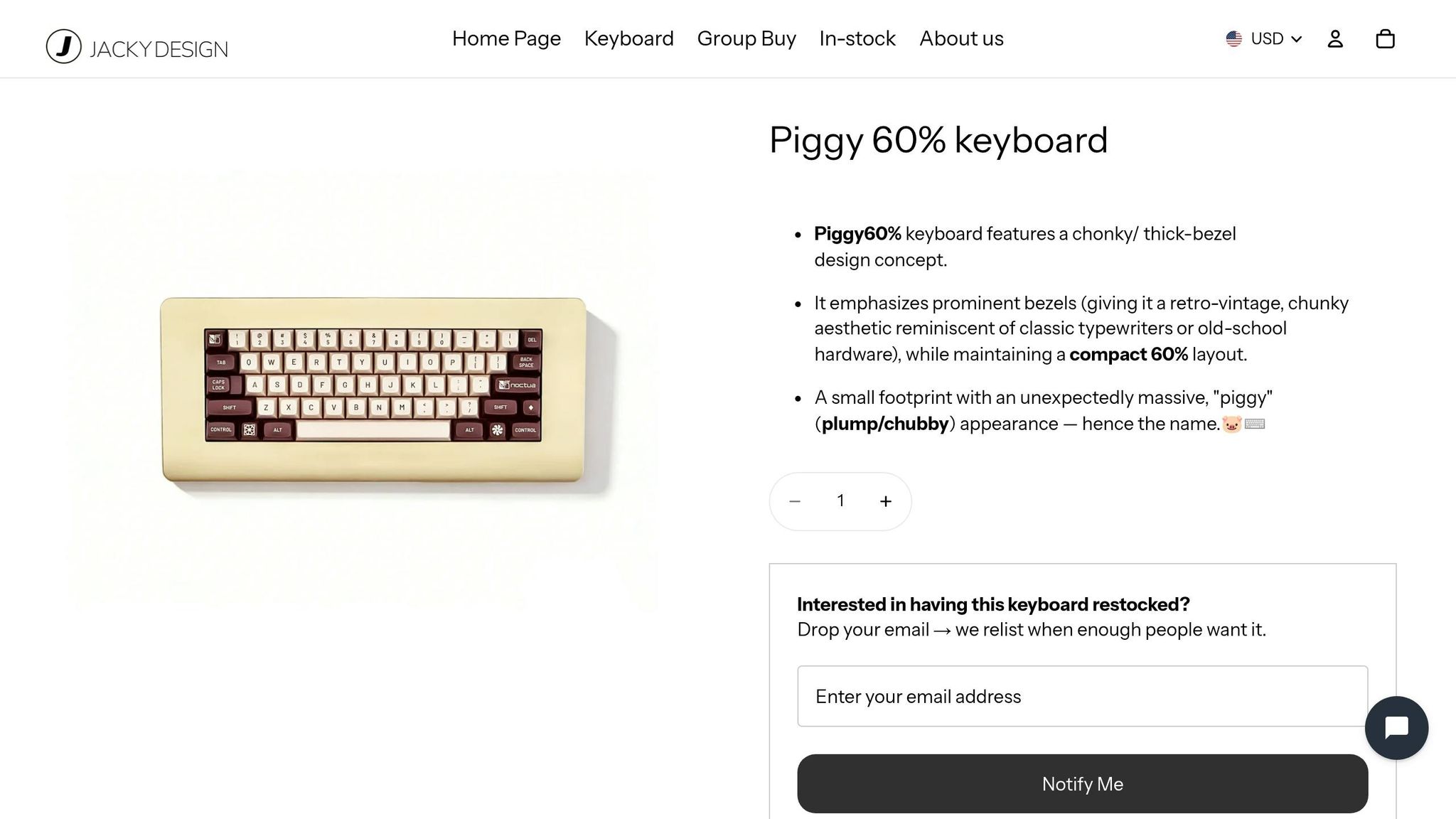
Tips on How To Enter Your First Keyboard Group Buy Safely featuring Piggy 60 Review
sbb-itb-3cb9615
1. Research the Organizer and Vendor
Before diving into a group buy, it's critical to investigate the organizer's reputation. The keyboard community has seen its fair share of failed projects, often due to organizers who weren't properly vetted. Doing your homework here can save you a lot of headaches.
Start by looking for physical prototype photos. While digital renders may look sleek, they can hide potential issues like poor finish, subpar materials, or flawed assembly. As KeebTalk member Laughmaster puts it:
If they don't have any prototype photos but they claim to have a sound test, RUN.
Also, check if the organizer provides detailed technical specs, such as case dimensions, typing angles, or exploded views. These details can give you a better sense of the product's design and assembly process.
Next, see if there's an active Geekhack thread for the project. These threads often document the project's journey from the Interest Check phase to fulfillment, offering valuable insight. Joining the organizer's Discord server can also give you a feel for real-time updates and reveal how they handle support inquiries or complaints.
It's also a good idea to look into the organizer's track record. First-time manufacturers or sellers operating solely through their own websites can pose greater risks. As Extra_Fox, a regular on KeebTalk, advises:
The biggest [red flag] for me is if the person making the offering is an unknown in any of the major keyboard markets... Or if they're 'known' it's their first shot at getting a board manufactured.
Lastly, make sure the vendor is committed to keeping participants informed with regular updates and clear timelines. By thoroughly researching the organizer and vendor, you'll have a solid foundation for evaluating the rest of the group buy.
2. Understand the Timeline and Phases
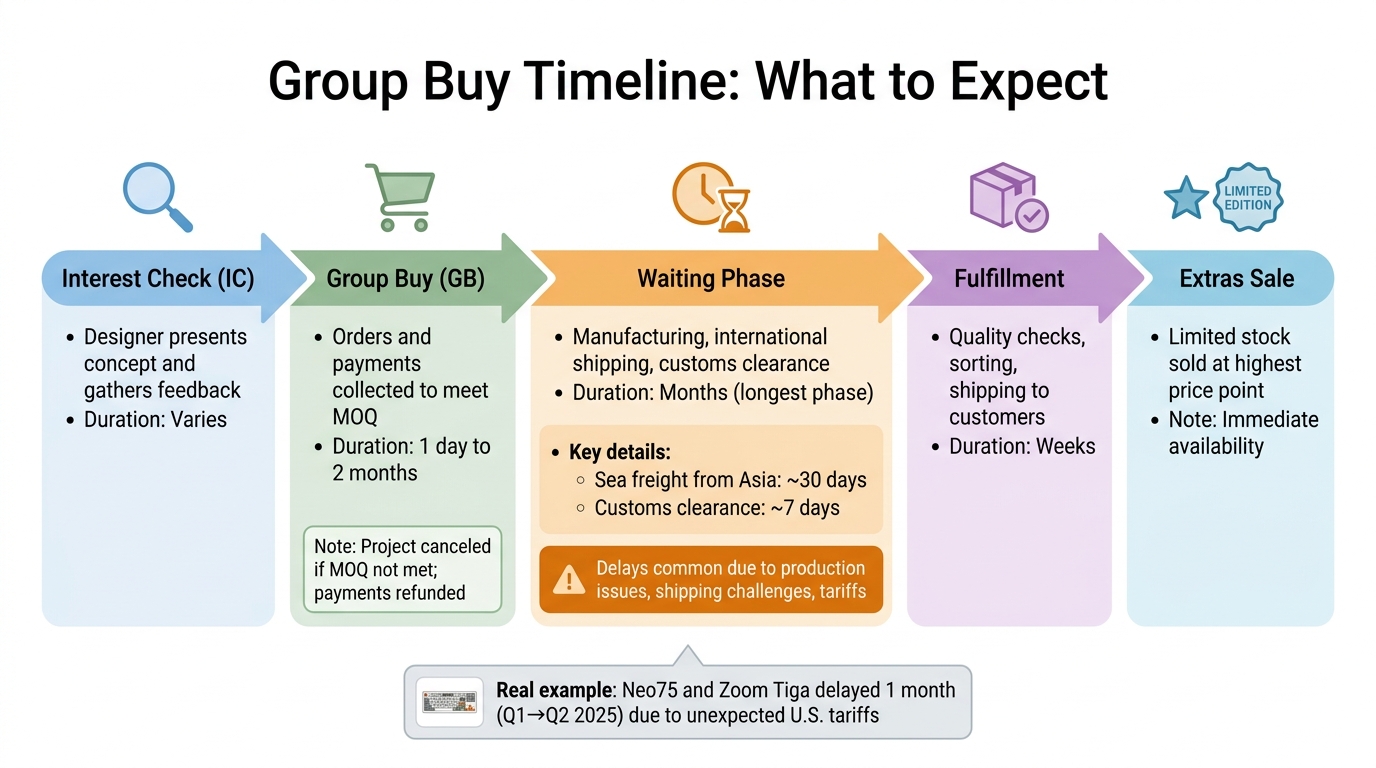
Group buys usually follow a structured timeline that can span weeks or even months. This process is divided into several key phases: Interest Check (IC), Group Buy (GB), Pre-order, Fulfillment, and Extras Sale. Each phase has its own purpose and sets expectations for participants, much like the fundamentals covered in our mechanical keyboards 101 guide.
The Interest Check phase is where it all begins. Designers present their concepts to gauge interest and gather feedback. Based on this input, they refine their designs before moving into the Group Buy phase. During this stage, orders and payments are collected to meet the manufacturer's Minimum Order Quantity (MOQ). This phase can last anywhere from a single day to two months. If the MOQ isn't met, the project is typically canceled, and payments are refunded.
After the Group Buy phase ends, the Waiting phase begins, which is often the longest and most unpredictable part of the process. At this point, the vendor places the bulk order with the manufacturer, and production gets underway. This phase includes manufacturing, international shipping (often by sea), and customs clearance. Delays can arise from production issues, shipping challenges, or customs bottlenecks. For instance, sea freight from Asia generally takes around 30 days, with an additional week for customs clearance.
Delays are almost a given in group buys. For example, in April 2025, KeebsForAll founder Jerry Chu announced a one-month delay for projects like the Neo75 and Zoom Tiga, pushing delivery from Q1 to Q2 2025. The delay was caused by unexpected U.S. tariffs that made previous shipping quotes invalid. Similarly, in May 2025, the JIRIS80 group buy faced manufacturing and quality assurance setbacks, ultimately resulting in non-fulfillment. These instances highlight the importance of staying updated - whether through vendor Discord channels, update blogs, or the group buy page itself.
Once the products reach the vendor's warehouse, the Fulfillment phase kicks in. Here, vendors perform quality checks, sort the items, and ship them to individual customers. After fulfilling all Group Buy orders, vendors may sell Extras - a limited stock offered at the highest price point to account for their immediate availability.
3. Budget for All Costs and Extras
The base price listed on a group buy page is often just the starting point. Once you factor in things like shipping fees, taxes, optional accessories, and potential surcharges, the final cost can be much higher. To avoid surprises, it’s important to calculate the total expense before committing.
Shipping fees are one of the biggest uncertainties. These costs depend on factors like the product's weight, size, and your location. Often, shipping is only estimated at checkout and can increase later. In fact, shipping prices frequently rise between when you place your order and when the item is shipped. For example, in June 2025, KeebsForAll reported that a customer in Puerto Rico faced shipping fees for the Neo75, S46, and Zoom Tiga group buys that jumped to over three times the original amount, requiring extra payment before the order could be fulfilled. If you’re ordering internationally, don’t forget to include import duties and taxes, which are based on your country’s customs rules and are typically your responsibility.
Additional costs don’t stop at shipping. Many group buys offer optional add-ons like deskmats, extra plates, or unique keycap sets. These extras are not included in the base price and can significantly raise your overall cost. Sometimes, these items are even billed separately. For instance, during the KAM Soda Squid group buy in June 2025, KeebsForAll noted that deskmats required a separate invoice from the keycaps, meaning participants had to juggle multiple payments for a single project.
To avoid financial stress, set a strict budget that includes a buffer for unexpected costs like shipping increases, taxes, and optional extras. Once you commit to a group buy, your funds are locked in, so it’s crucial to confirm the total amount with the vendor upfront.
4. Choose a Secure Proxy or Payment Method
Group buys require upfront payments that are non-refundable to meet the manufacturer’s minimum order quantity (MOQ). These payments are typically non-cancellable as well. As Mech Keybs explains:
Joining Group Buys is quite risky... you risk giving your money to a manufacturer probably halfway across the world who may not even deliver on his promise.
Because of these risks, working with a trusted proxy is crucial. When joining international group buys, proxies act as regional intermediaries, handling bulk shipments from manufacturers - often based in China - to local warehouses. Reliable proxies don’t just manage logistics; they also perform quality control and maintain clear communication through Discord or support emails. For instance, in May 2025, KeebsForAll served as the regional proxy for group buys like the Neo75, S46, TB8, and Zoom Tiga. They began quality checks at their Los Angeles warehouse as soon as early shipments arrived from China.
After selecting a dependable proxy, secure your payment through established platforms. Check the proxy’s security measures before transferring funds. Trusted proxies often rely on platforms like Shopify, which include tools to detect high-risk transactions. Look for transparent policies on shipping, returns, and replacements - reputable services will clearly outline fees, such as a standard 3% restocking fee for eligible returns. To further protect your purchase, consider third-party package protection services like Route Package Protection, which can cover shipping-related issues. Be sure to clarify any extra charges, such as international transaction fees, with your proxy to avoid surprises.
If you’re an international customer, be prepared to pay import duties, taxes, and other fees upon delivery. Some vendors offer flat-rate shipping to certain regions (e.g., $20 to Canada), while others calculate fees based on weight and destination. Always confirm total costs ahead of time and document your package’s condition with photos when it arrives. Most replacement requests must be submitted within a short window - often 14 days.
5. Check In-Stock Options First
Before diving into a group buy, it’s worth checking out in-stock options from reliable vendors. These items are already sitting in a warehouse and typically ship within 24 to 72 business hours. Domestic orders often arrive in 5–7 business days, while international deliveries take about 7–16 days. This is a much faster alternative to the long wait times associated with group buy manufacturing and shipping, which can stretch into months - or even years. Plus, in-stock purchases come with better consumer protections.
One key advantage of in-stock items is the flexibility they offer. Most products can be returned within 14 days of receipt, and if you change your mind before the item ships, you can cancel the order (though there’s a 3% processing fee). As KeebsForAll puts it:
In-stock products are immediately available from a KFA warehouse and ship within days.
Keep an eye on the "Newly In-Stock" collections. Premium keyboards like the MKC75 ($199.00) and NotFromSam S65/80 V2 (starting at $329.00) frequently show up after their group buy phases. If you missed out on a specific group buy, the KFA Marketplace is another great resource. It features verified units from previous releases, which ship in weeks instead of months. Additionally, many in-stock orders over $70 qualify for free shipping within the U.S..
Just a quick tip: If you’re ordering both in-stock and pre-order items, place them as separate orders. Otherwise, your shipment will be delayed until the pre-order is ready to go.
6. Prepare Assembly Tools and Parts
When your group buy keyboard finally ships, you’ll want to hit the ground running. Since these kits often take months to arrive, use that waiting period to gather all the tools and components you’ll need. Being prepared ahead of time means you can dive right into building once your package is in hand.
Start by checking what’s included in your group buy kit. Many kits only come with the chassis and PCB, so you may need to source extra switches, keycaps, and stabilizers yourself. Carefully review the product page to avoid surprises and ensure you’ve got everything covered.
Having the right tools is just as important. Here are a few essentials to keep on hand:
- Switch opener: Perfect for prepping your switches, with prices ranging from $5–$10. KeebsForAll offers their KFA Switch Opener for $19.00.
- Tweezers: Handy for managing small parts during assembly.
- Compact screwdriver set: A must for securing everything in place.
- Lubricant and brush: Krytox 205g0 is a go-to for lubing switches and stabilizers, starting at $7.95 for smaller quantities. Use a small brush ($3–$5) for precise application - just 0.5–1 drop per switch is enough.
Lubing your switches and stabilizers can make a big difference in how your keyboard sounds and feels. Take your time with this step for the best results.
Lastly, stay organized. Create a checklist to confirm your PCB type (hotswap or soldered), layout (ANSI, ISO, 60%, 75%, TKL), and stabilizer sizes (commonly 2u, 6.25u, or 7u). Use labeled containers to keep all your components in order and avoid losing anything during the build process. With everything ready to go, you’ll set yourself up for a smooth and enjoyable assembly experience.
7. Plan for Delays and Manage Expectations
When it comes to group buys, delays are pretty much par for the course. Manufacturing hiccups, customs holds, and shipping slowdowns can all throw off timelines, so it’s best to treat estimated delivery dates as flexible rather than set in stone. Many vendors avoid giving early ETAs for this very reason. As Jerry Chu, Founder of KeebsForAll, puts it:
I do not yet have an ETA this early, as those are usually misleading and often causes customer frustration.
This unpredictability makes it crucial to plan ahead and manage your expectations.
Take the GEON F1-8X-V2 as an example. This keyboard faced multiple delays due to international tariffs and logistical headaches. And when the units finally arrived, things got messier - about 16 orders couldn’t be fulfilled because the manufacturer sent the wrong color and configuration combinations.
So, how can you stay on top of things? Joining the vendor’s Discord server is a great move. These servers often share real-time updates about shipping and quality control - details that might not make it to the main website right away.
If delays start to feel overwhelming, there’s always the KFA Marketplace. This platform offers verified options for quicker shipping. Items sold here are checked by KeebsForAll at their warehouse before they’re shipped out. While there’s a 6.5% fee for using the marketplace, items typically ship within two to three weeks.
Another tip: make sure your contact information is up to date. If your payment processor flags your order as high-risk for fraud, you might need to provide ID verification, which could delay shipping until the issue is cleared up. Ultimately, expecting delays as part of the process can help you stay patient and explore alternatives when needed.
Conclusion
Joining a keyboard group buy combines the thrill of customization with the need for careful planning. In these setups, enthusiasts pool their funds to access high-quality, custom products at competitive prices. However, this comes with trade-offs like extended wait times and certain risks. To make the most of it, research the vendor’s reputation, confirm the existence of physical prototypes, and stay updated on progress.
The key is understanding the balance between cost and patience. As KeebsForAll puts it:
By paying now, you get the lowest prices in exchange for waiting for manufacturing times.
Delays caused by shipping issues or manufacturing problems are always a possibility. That’s why thorough preparation and realistic expectations are so important.
Make sure to budget for everything: the keyboard itself, extras, shipping costs, and any unexpected increases. If waiting isn’t your style, consider alternatives like post-fulfillment extras, in-stock items, or the KFA Marketplace for faster shipping options.
A big part of the group buy experience is the sense of community. It’s not just about buying a product - it’s about being part of a collective effort to bring custom designs to life. Stay involved, ask questions, and keep your expectations grounded. As KeebsForAll reminds us:
Manufacturing premium keyboards and keycap sets is not a cheap and easy process!
Jerry Chu from KeebsForAll also emphasizes:
It's up to the designer and the manufacturer to produce the products and ensure quality control on time for you.
FAQs
What are the biggest red flags in a group buy?
When joining a keyboard group buy, there are a few warning signs you should never ignore. A major one is lack of transparency about the vendor's reputation. If you're unsure about their track record, that's a big pause moment.
Another red flag? Unclear or excessively long wait times. While delays can happen in group buys, the vendor should provide realistic timelines and updates. Poor communication about progress or setbacks is also something to watch out for - if they’re not keeping you in the loop, that’s a problem.
Be cautious of inconsistent pricing, vendors with a history of missed deadlines, or unresolved issues from past group buys. These are all signs that things might not go smoothly. To protect yourself, always research the vendor and check what the community says about them. It’s better to spend a little extra time upfront than to deal with scams or endless delays later.
How much extra should I budget beyond the base price?
When participating in group buys, it's wise to set aside an extra 5% to 20% of the base price for additional costs. These might include shipping fees, taxes, import duties, or charges from unexpected delays or cancellations. Planning for these expenses ensures you're not caught off guard and helps you stick to your budget.
What should I do if my group buy gets delayed?
If your group buy faces delays, make sure to stay in the loop by keeping an eye on official updates from the seller. Check your email and any discussion threads tied to the purchase for new information. If things still seem unclear, don’t hesitate to reach out directly to the seller or organizer for details and an updated timeline. While waiting, stay patient and continue monitoring for any progress updates regarding your order.