
If your keyboard feels slick, loud, or worn, PBT keycaps can change that fast. I’d sum it up like this: PBT usually gives me more grip, less shine over time, and a lower-pitched sound than ABS. On many sets, thicker walls around 1.5 mm to 1.6 mm also help cut some of the hollow noise.
Here’s the short version:
- Texture: PBT feels more matte and dry under my fingers
- Sound: PBT often sounds lower and less sharp than ABS
- Wear: PBT tends to resist oily shine better with daily use
- Fit: I still need to check stem type, layout, profile, and long-key warp
- Limits: Keycaps matter, but switches, plate, and case still shape the final feel
If I want to test the difference the right way, I swap only the keycaps on the same board and compare feel, sound, and shine after a few days.
Quick comparison
| Point | PBT | ABS |
|---|---|---|
| Surface feel | Matte, slightly textured | Smoother, often slicker with use |
| Sound | Lower, rounder | Higher, sharper |
| Shine over time | Slower to show | Faster to show |
| Long-session grip | Better for sweaty hands | Can feel slippery |
| Common tradeoff | Not every set sounds deep | Can feel smooth at first |
So my takeaway is simple: if I type a lot and want a keyboard that stays more consistent, PBT is often the first keycap material I’d try.
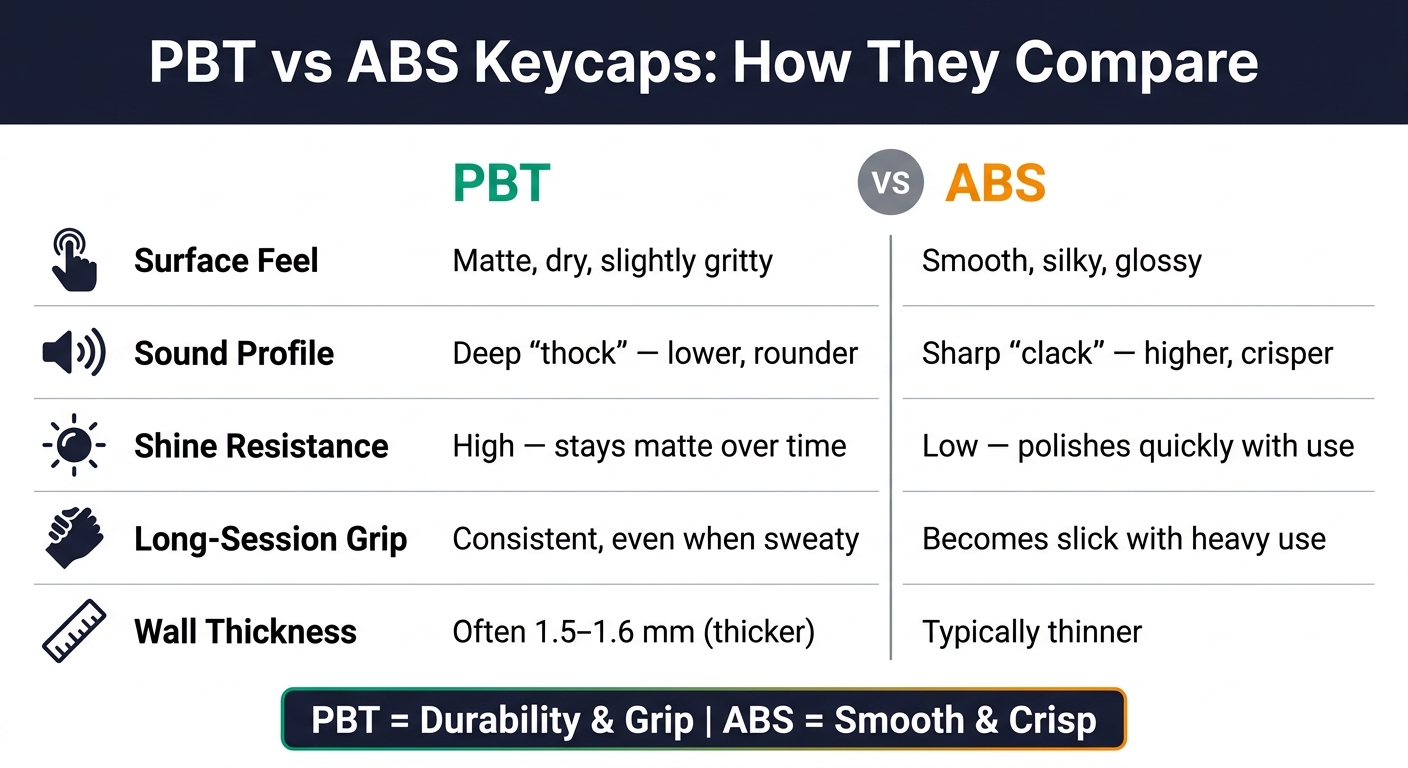
PBT vs ABS Keycaps: Side-by-Side Comparison
ABS VS PBT Keycaps, With Sound Test. SHOULD YOU CHANGE YOURS?
sbb-itb-3cb9615
How PBT Material Properties Affect Texture and Sound
PBT's density changes how a keycap feels, sounds, and wears. In plain terms, PBT keycaps are often thicker, harder, and longer-lasting than ABS.
Texture: More grip during long typing sessions
First, PBT changes the way the surface feels under your fingers. A PBT keycap usually has a matte, slightly grainy surface. That texture comes from the mold itself, not from a coating added later. So what do you get? A dry, grippy feel that tends to stay the same over time.
You notice this most during fast touch-typing or long work sessions, especially when your hands start to get warm. That extra grip can make the keyboard feel more secure and easier to use for hours at a time.
Sound: A deeper, less sharp keypress
PBT's density also changes the sound of each keypress. Because the material helps damp vibration, PBT often gives off a lower, rounder sound than ABS. Think of it as the gap between a crisp "clack" and a deeper, rounder "thock."
Thicker caps usually sound fuller too. Premium PBT sets often come with wall thicknesses of 1.5 mm to 1.6 mm, which adds mass and cuts down on the hollow ring you can get from thinner caps.
That said, keycap material is only part of the picture. Your switches, plate material, and case build all shape the final sound. PBT changes the starting point, but it doesn't cancel out everything else. You'll hear that most clearly when you test PBT and ABS on the same board. You can find a variety of PBT keycap sets to experiment with different textures.
Durability: Shine resistance and consistent feel over time
PBT also does a better job of resisting skin oils, so it keeps that matte surface longer and stays more consistent with heavy use. In practice, your most-used keys are less likely to turn slick and shiny. The feel you start with is, for the most part, the feel you keep.
How to Compare PBT and ABS on Your Own Keyboard
You can spot the difference between PBT and ABS with a few fast tests at home. The best way to do it is simple: try both materials on the same keyboard using different keycap sets so the board itself doesn't muddy the result.
A quick at-home texture and shine test
Start with the finger-slide test. Slowly move your fingertip across a PBT key, then do the same on an ABS key. PBT should feel a bit grippier, while ABS tends to feel smoother.
Next, check your most-used keys under bright light. Look for shine on spots like WASD, Space, or Enter. ABS usually starts to polish and gloss up faster than PBT.
A simple sound comparison using the same board and switches
Record a short typing sample with each keycap set using the same board, the same switches, and the same room. That part matters. If you change the setup, it's harder to hear what the keycap material is doing.
When you play the clips back, listen for pitch and sharpness. PBT usually sounds deeper, while ABS comes across sharper. The gap won't always hit you over the head, but once you hear it, it's pretty easy to pick out.
PBT vs. ABS typing feel: side-by-side comparison
Use the tests above, then compare what you hear and feel with the chart below.
| Property | PBT Experience | ABS Experience | What you'll notice |
|---|---|---|---|
| Texture | Dry, gritty, matte | Smooth, silky, glossy | PBT gives you more grip; ABS feels faster but can get slippery |
| Sound | Deep "thock" | Sharp "clack" | PBT feels more solid; ABS feels more crisp and responsive |
| Shine | High resistance | Low resistance | ABS gets slick over time; PBT stays more consistent |
| Grip | Consistent, even when sweaty | Becomes slick with use | PBT works better for long sessions and marathon typing |
How to Choose and Install PBT Keycaps
Once the texture and sound differences are clear, the next move is simple: make sure the set fits your keyboard before you buy it.
What to check before you buy
If you already know PBT changes how a board feels, now you're down to fit, layout, and a few details that can save you a headache later.
Start with stem fit. Most PBT keycaps use MX-style stems, which means they work with Gateron, Kailh, and most modern switches.
Next, check layout support. A standard ANSI (U.S.) layout uses 1.25u modifiers and a 6.25u spacebar. Smaller boards can get a little tricky. On a 65% or 75% board, you may need a 1.75u right Shift or 1u bottom-row keys, so read the kit's compatibility list before you place the order.
Profile matters too. Cherry and OEM are sculpted, which means each row has a different shape. DSA and XDA are uniform, so every row has the same profile. If wear is your main concern, double-shot PBT tends to last the longest. Dye-sub also holds up well, but it does not support RGB shine-through.
One more thing: inspect long keys like the spacebar for warping, especially on budget sets. A set can look fine in photos and still show issues where it counts.
Once fit is sorted, the swap itself is pretty fast.
How to swap keycaps without damaging your board
Take it slow. Keycap swaps only take a few minutes, but rushing is how people scratch caps or bend something they didn't mean to touch.
- Unplug your keyboard before you start so you don't trigger random inputs.
- Use a wire keycap puller, not a plastic ring puller. Plastic pullers can scratch the sides of your caps. Slide the wires under the edges of the key, then pull straight up with even pressure.
- While the caps are off, clear the plate. A quick pass with compressed air or a soft brush can get dust and debris out from the plate and between the switches.
- Install row by row. On sculpted profiles, each row from R1 to R4 has a different angle. Match the row number and legend direction before you press the cap onto the stem. For stabilized keys like the spacebar or Enter, make sure the cap sits flush on both the center switch and the stabilizer stems.
Finding in-stock PBT sets at KeebsForAll
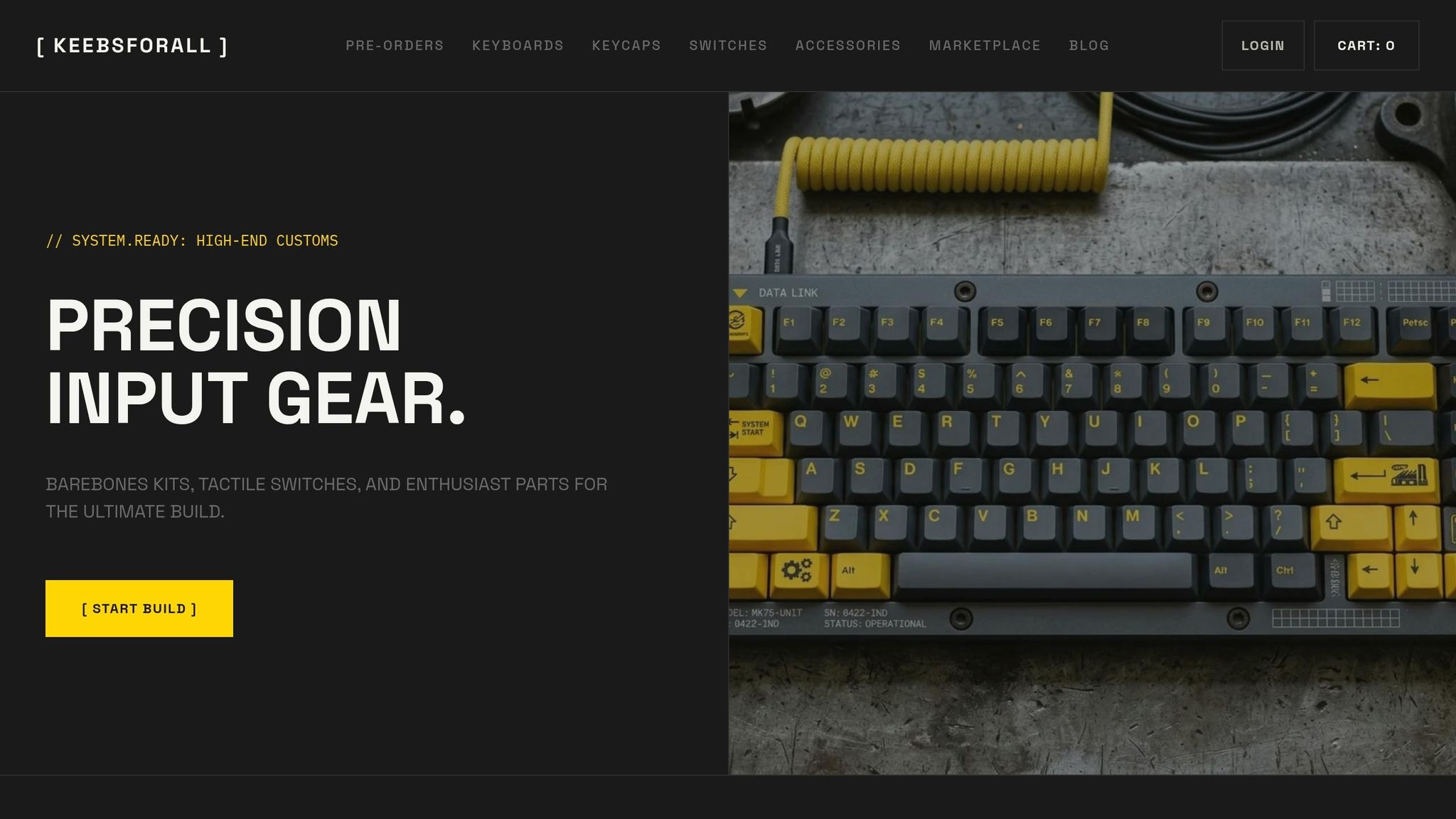
KeebsForAll carries in-stock PBT sets and hot-swappable boards, so you can try the feel of PBT without soldering.
Conclusion: When PBT Keycaps Are Worth the Switch
PBT makes the most sense if you type a lot, want a bit more grip, and prefer keycaps that keep their matte finish longer. It also tends to sound a little deeper and more muted, especially with thicker sets.
That said, PBT doesn't fix everything. The final typing feel still comes down to cap thickness, profile, switches, and the rest of the build. A thin PBT set won't suddenly give you a deep sound on its own. But if those are the traits you're after, PBT is one of the easiest upgrades to try first.
Key points to remember
- What PBT changes: surface texture, with a matte feel and drier grip, plus better resistance to shine so the look stays more consistent over time
- What still depends on the build: sound profile, which is shaped by switches, wall thickness, and mounting style, along with layout fit, which still needs to match your board
The simplest way to know if it's right for you is to swap only the keycaps on your current board and use them for a few days. That kind of side-by-side test tells you a lot. If your usual board feels better with the new caps, PBT is probably a good long-term pick.
If you're ready to try it, KeebsForAll carries in-stock PBT sets and hot-swappable boards, so you can test the feel without soldering.
FAQs
Are PBT keycaps always thicker than ABS?
No. PBT keycaps are not always thicker than ABS keycaps.
PBT is often denser, and many PBT sets are made with thicker walls. That can help with sound and long-term wear. But thickness comes down to how the keycaps are made, not just the material itself.
So yes, you’ll often see thicker PBT sets on the market. But a cheap or poorly made PBT set can still feel thin, uneven, or a bit all over the place. Thickness can also change from one brand to another, and even between production runs from the same brand.
Will PBT keycaps fit my keyboard?
It depends on the stem type and your keyboard layout.
Most modern mechanical keyboards use cross-shaped stems that follow the Cherry MX standard. That means most PBT keycap sets will fit.
That said, not every keyboard plays by those rules. PBT keycaps may not fit boards with proprietary designs, low-profile switches, or switch types like Topre.
You’ll also want to check the key sizes in the set. A set can match the stem and still miss your layout. This matters a lot for boards like 65% and 75%, which often use different key sizes for keys like Shift, Alt, or the bottom row.
Do PBT keycaps make every keyboard sound deeper?
No. PBT keycaps can make a keyboard sound lower-pitched or more “thocky,” but they won’t make every keyboard sound deeper on their own.
The final sound also depends on a few other parts of the build, including:
- keycap thickness and profile
- switch type
- mounting style
- case construction
So while keycaps can shift the sound, they’re only one piece of the puzzle.