
If you want a premium CNC keyboard case, aluminum is usually the best middle ground. I’d sum it up like this: it gives you better rigidity than plastic, less weight than brass or steel, and a finish that holds up well over time.
Here’s the short answer:
- Plastic and polycarbonate cost less, but they flex more and show wear sooner.
- Steel and brass add mass, but they cost more to machine and can make a board too heavy.
- Aluminum lands in the middle: stiff, light enough for daily use, and easy to finish with anodizing or e-coating.
- In the common $160 to $250 range, that balance is a big reason aluminum shows up so often.
- Common alloys like 6061 and 6063 let brands tune for stiffness, sound, and machining cost.
- Typical aluminum boards often land around 3.3 to 5.5 lb, which helps keep them steady on a desk without going overboard.
If I were comparing case materials in plain terms, I’d look at weight, sound, stiffness, wear, and machining cost. That’s where aluminum keeps winning.
Anodized Aluminum 60% Case Review
sbb-itb-3cb9615
Quick Comparison
| Material | Weight | Feel / Sound | Wear Over Time | Main Tradeoff |
|---|---|---|---|---|
| Aluminum | Medium | Firm, controlled, balanced | Holds finish well | Not the lightest |
| ABS Plastic | Light | More hollow, less solid | Can yellow or flex | Lower stiffness |
| Polycarbonate | Light to medium | Softer, deeper, muted | Scratches more easily | Less rigid |
| Steel | Heavy | Bright, sharp | Very tough | Harder to machine |
| Brass | Very heavy | Deep, bass-heavy | Can tarnish | High weight and cost |
So the main point is simple: aluminum does not top every single category, but it avoids the biggest downsides of the other options. That’s why it became the default pick for many CNC keyboard cases.
The Problem: Why Other Keyboard Materials Come With Bigger Tradeoffs
Every CNC keyboard case comes with tradeoffs. Plastic keeps costs down but gives up rigidity. Heavier metals add stability, but they also push up price and make machining tougher. Aluminum sits in the middle. It stays rigid, machines cleanly, and still works at scale.
Plastic and Polycarbonate: Lower Cost, Less Rigidity
Plastic and polycarbonate are built around cost first, not top-end performance. Polycarbonate, in particular, gives off a softer, more muted sound that some typists like. But in most premium builds, the downsides add up fast.
The biggest issue is structural rigidity. Plastic cases can flex under pressure, especially near the center of the board, and you can feel that when typing. CNC aluminum creates a stiffer shell with fewer weak points. Molded plastic cases also tend to be less precise, with mold lines or sink marks left behind by injection molding. CNC machining is a different story. It can hold tolerances as tight as ±0.01 mm, which matters when a PCB and plate need to fit into a tight case without fuss.
Durability over time is another gap. Polycarbonate can pick up micro-abrasions and visible scratches after years of use, while anodized aluminum holds up better against wear and is less likely to crack or bend. A dual-material board like the Halo96 V2 makes the contrast easy to see: aluminum feels firmer and wears better, while PC feels softer but marks up more easily.
Steel, Brass, and Exotic Metals: Hard to Scale
At the other end, heavier metals have the opposite issue. They can feel more premium in the hand, but they get much harder to justify once production grows.
Stainless steel resists scratches and adds serious stability, but it also causes much more tool wear during CNC processing than aluminum. That slows production and drives costs up. Brass (C360) costs about $12–$18/kg in raw material, which is close to double the price of standard aluminum alloys, and it tarnishes over time, so it needs regular polishing. Its density is 8.50 g/cm³, compared with 2.70 g/cm³ for 6061 aluminum. In plain terms, brass can make a finished keyboard far heavier than most people want on their desk.
Titanium pushes this even further. It has steep material and machining costs, which makes it a fit for small-batch or experimental cases more than mainstream production.
"Titanium... Very high material and machining cost, difficult to process. Used only in small-batch or experimental cases." - Jason Dong, Founder, MachMaster
These metals make sense for niche goals. They do not fit the general need for a premium CNC case that is durable, consistent, and cost-effective. That’s why aluminum became the standard benchmark.
The Solution: Why Aluminum Became the Default for CNC Keyboard Cases
Given those tradeoffs, aluminum solves the most problems without causing a new set of headaches. It became the default for CNC keyboard cases for a simple reason: it hits the sweet spot. It’s rigid enough, light enough, and easy enough to machine in larger production runs.
Machinability, Finish Quality, and Scalable Production
The two alloys you’ll see most often in keyboard production are 6061 and 6063. 6061-T6 has a tensile strength of about 45,000 psi, which makes it the better pick when structural rigidity matters most. 6063-T6 is lower at about 35,000 psi, but its machinability rating climbs to 80%, so it’s faster and less expensive to CNC in high-volume runs.
That’s the tradeoff in plain English: 6061 is used when stiffness comes first, while 6063 is picked when machining speed and cost matter more. Since both sit in the same material family, manufacturers can adjust stiffness and production speed without moving to a totally different metal.
Aluminum also works well with anodizing, bead blasting, and e-coating, which gives manufacturers more control over how a case looks and feels . Those finishes change color, surface texture, corrosion resistance, and wear.
"Aluminum is the industry standard due to its excellent strength-to-weight ratio and ease of finishing." - Jucheng CNC Machining
Those production wins don’t just help the factory side. They also shape how the keyboard feels on your desk.
Weight, Rigidity, and the Typing Feel Enthusiasts Expect
A typical CNC aluminum case weighs about 1.1 to 3.3 lbs for TKL-size boards . That’s heavier than plastic, but still much easier to live with than a brass or steel case. You get enough mass to keep the board steady during fast typing without turning it into a brick.
That extra stiffness matters too. A rigid shell cuts down on flex that can change how keystrokes feel and sound. And for keyboard hobbyists, that part matters a lot.
The alloy itself can also shift the sound profile. 6061 aluminum tends to give you a higher-pitched, crisper “clack,” while 6063 leans more toward a deeper “thock” because it’s softer and has better natural damping. If someone is tuning a build for sound, that difference isn’t small.
Durability and Long-Term Ownership
Aluminum holds up well in normal indoor use. It resists cracking, bending, yellowing, and corrosion. Anodized surfaces are also easy to maintain, usually with nothing more than a microfiber cloth and distilled water.
That matters over time. A well-made aluminum keyboard can stay in use for years without much upkeep. It also tends to hold its value better, which helps explain why aluminum remains the baseline material for premium CNC keyboard cases.
Aluminum vs. Other CNC Case Materials
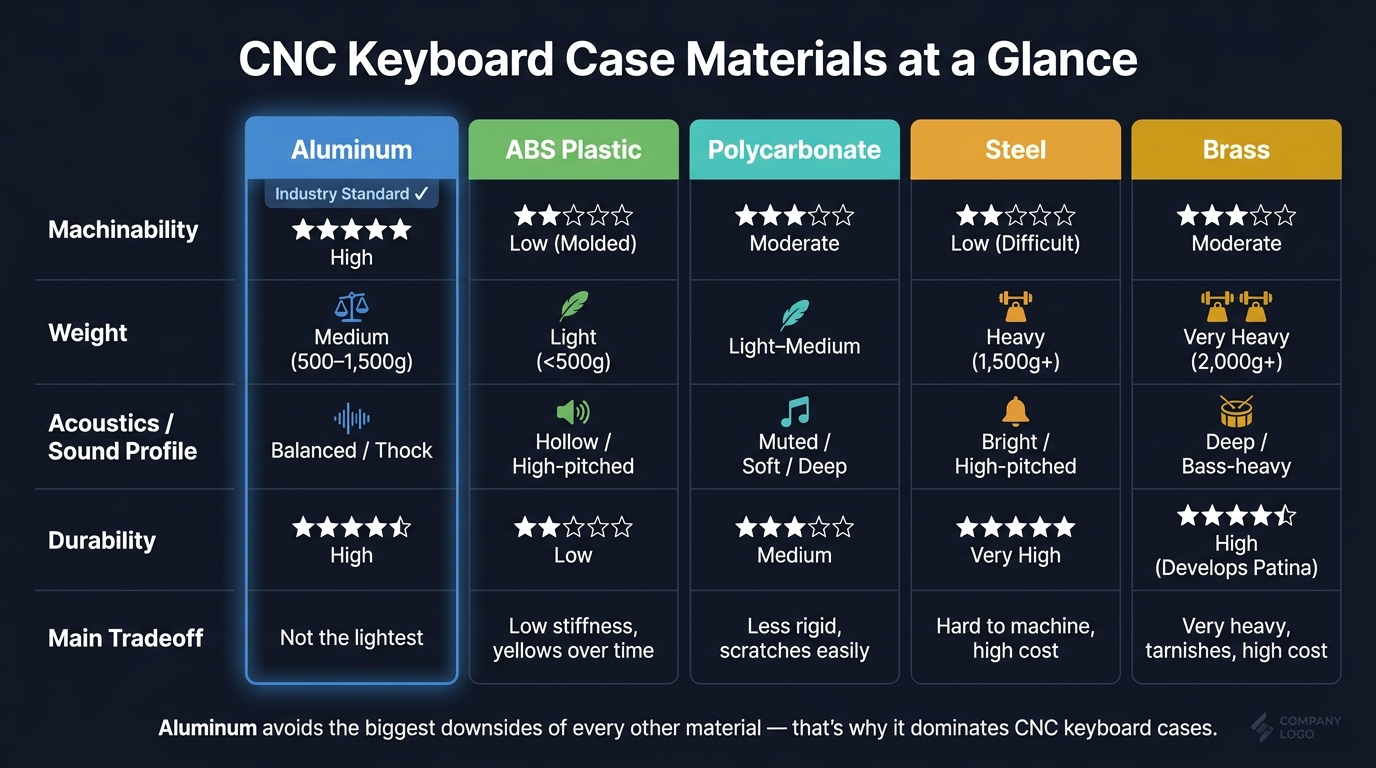
CNC Keyboard Case Materials Compared: Aluminum vs. Plastic, Steel & Brass
The real comparison isn't just about strength. It's about how each material handles weight, finish, and machining cost at the same time. In practice, the best choice usually isn't the one that dominates a single category. It's the one that stays usable across all of them.
| Material | Machinability | Weight | Acoustics | Durability |
|---|---|---|---|---|
| Aluminum | High | Medium (500–1,500g) | Balanced / "Thock" | High |
| Plastic (ABS) | Low (Molded) | Light (<500g) | Hollow / High-pitched | Low |
| Polycarbonate | Moderate | Light to Medium | Muted / Soft / Deep | Medium |
| Steel | Low (Difficult) | Heavy (1,500g+) | Bright / High-pitched | Very High |
| Brass | Moderate | Very Heavy (2,000g+) | Deep / Bass-heavy | High (Develops Patina) |
Aluminum vs. Plastic and Polycarbonate
ABS is molded, which helps keep costs down, but it also limits precision and stiffness. It often sounds hollow, and it can yellow over time. Polycarbonate is a closer match to aluminum. It's CNC-machinable, impact-resistant, and common in gasket-mount builds. In some of those boards, that softer feel is part of the appeal, giving the case a lighter and more flexible character.
Aluminum has a clear edge in surface treatment. It supports anodizing and E-coating, which helps it resist wear better than PC. That's where aluminum starts to pull ahead if you want a case that looks clean after long use.
Aluminum vs. Steel and Brass
Heavy metals add mass, but they also make a board less practical. Brass cases can go past 2,000g, which makes them costly to ship and annoying to move around. Steel is even tougher to machine, and that pushes production costs higher.
Brass gives the deepest bass response of any common keyboard material. That's a big reason it's often used as an internal weight inside aluminum cases instead of being used for the full case. Steel, by contrast, tends to sound bright and high-pitched. Many enthusiasts try to dampen that sound, which leaves steel as more of a niche pick.
That's why aluminum still ends up as the default for most premium CNC cases.
That balance is easiest to see in real boards.
Real Examples and Conclusion: Why Aluminum Still Leads
How the Freebird Series Shows Aluminum's Practical Advantages
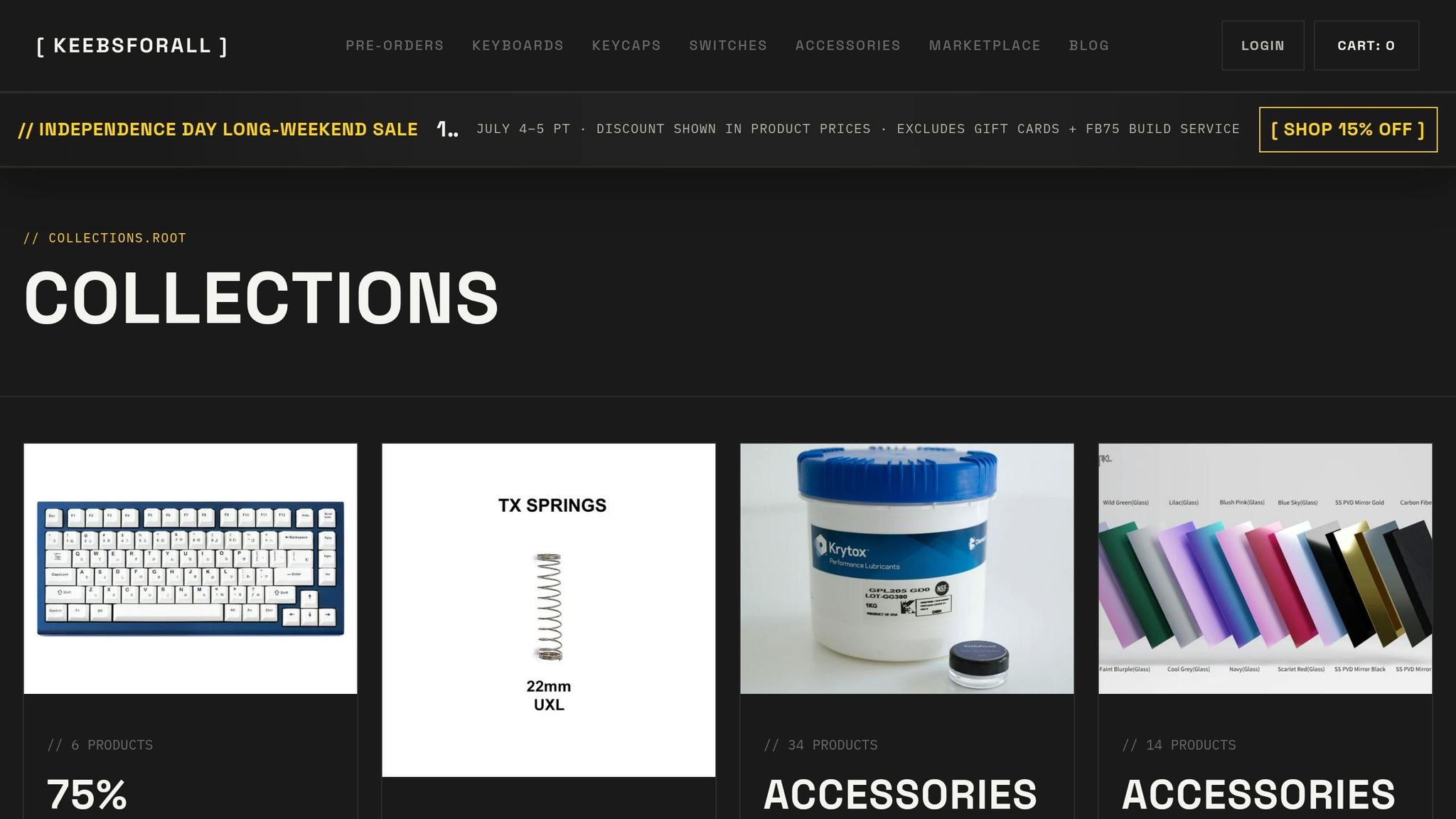
You can see that balance in the Freebird series from KeebsForAll. It's a clear case of why aluminum keeps showing up in keyboard builds. The machining allows parts to fit neatly, and the board feels solid in hand. On top of that, anodized aluminum helps the case hold up against scratches and day-to-day wear.
What Aluminum Does Not Solve and Why It Still Wins
Aluminum isn't perfect. At roughly 3.3 to 5.5 lb (1.5 to 2.5 kg), it isn't a good travel pick. It can also feel cold in a chilly room. And when stabilizers or switches aren't tuned well, aluminum's hard, reflective surface can make those flaws easier to hear. That's why many builds use foam dampening to shape the sound.
Even with those trade-offs, aluminum still comes out on top in practice because it offers a strong mix of rigidity, machining, finish quality, corrosion resistance, and cost.
FAQs
Is aluminum worth the extra cost?
It depends on what matters most to you.
Aluminum gives you more rigidity, better wear resistance, a premium solid feel, and a more controlled sound than plastic.
The higher price tag comes from CNC machining, material waste, and labor-heavy finishing. It can feel more high-end, but it’s also less forgiving. In some builds, you may need to tune switches and stabilizers with extra care to avoid resonance or metallic ping.
Which aluminum alloy is better, 6061 or 6063?
Neither is clearly better. It comes down to what matters more to you: looks, sound, or stiffness.
6061 is stronger and denser. It has a stiffer, no-flex feel, plus a higher-pitched, tighter sound.
6063 has a smoother finish and tends to anodize better. It also feels a bit softer, which often leads to a deeper, more muted sound.
Are aluminum keyboards too heavy for daily use?
No. For daily use, aluminum keyboards usually don’t feel too heavy. In fact, the weight is often part of the appeal.
At about 500 g to 2,500 g, that extra heft helps the keyboard stay put instead of sliding around while you type or game. They’re not the best pick if you need something easy to carry, but a lot of people like the solid, premium feel.