
If you're buying mechanical keyboards, you'll encounter three main purchasing options: Group Buy, Pre-Order, and In-Stock. Each has its own pricing, wait times, and risks. Here's a quick breakdown:
- Group Buy: Pay upfront for a product that starts production only if enough people order. You'll wait 6–18+ months, but prices are lower, and designs are often limited-edition. However, delays and cancellations are possible.
- Pre-Order: Reserve a product already in production. Wait times are shorter (weeks to months), and the risk of cancellation is minimal. Prices are higher than group buys but lower than in-stock.
- In-Stock: Buy items ready to ship immediately. No waiting, but prices are the highest, and availability is limited to what’s in inventory.
Quick Comparison:
| Feature | Group Buy | Pre-Order | In-Stock |
|---|---|---|---|
| Price | Lowest | Mid-range | Highest |
| Wait Time | Long (6–18+ months) | Moderate (weeks/months) | Minimal (days) |
| Risk | High (delays/cancellations) | Low | Minimal |
| Availability | Limited-time designs | Limited stock | Current inventory |
Your choice depends on whether you prioritize cost, speed, or exclusivity. Avoid mixing these options in one order to prevent delays.
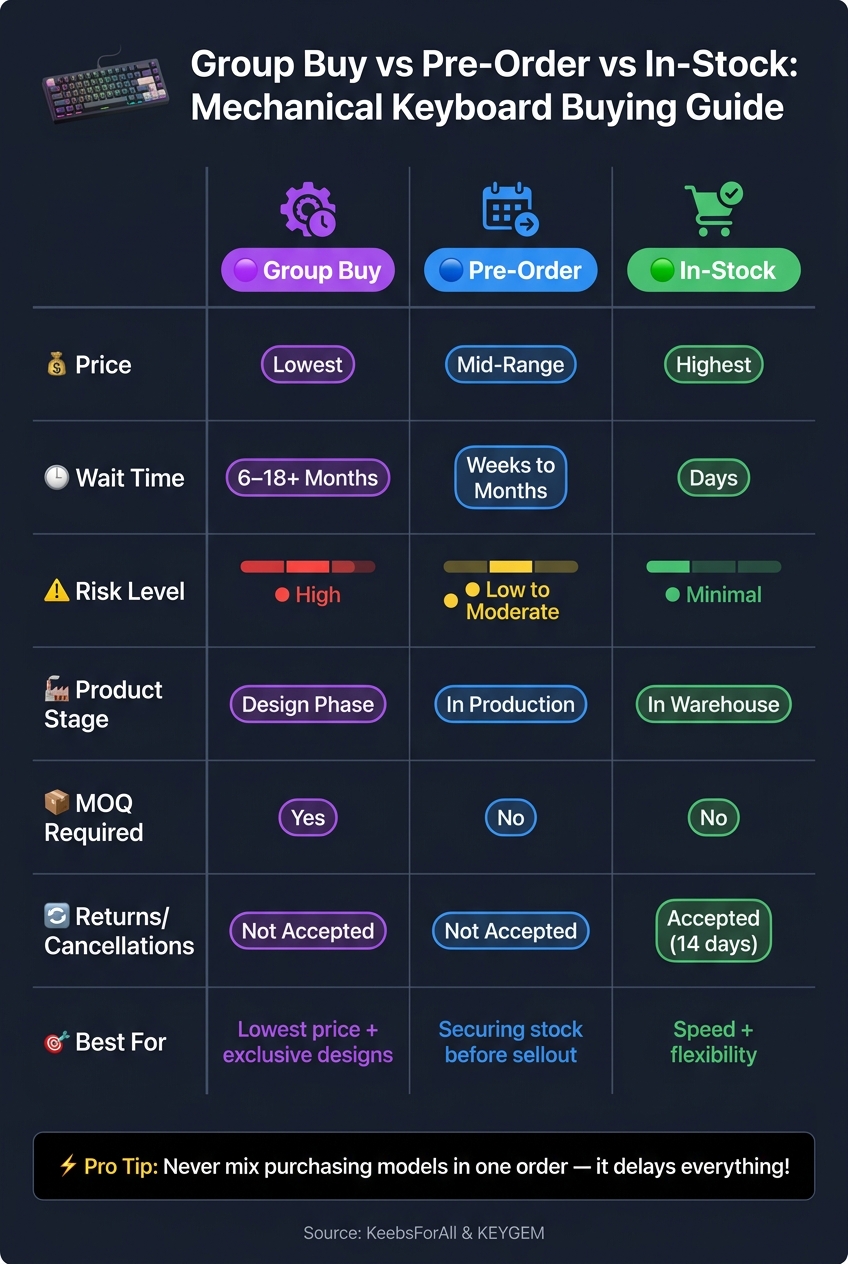
Group Buy vs Pre-Order vs In-Stock: Mechanical Keyboard Buying Guide
The REAL TRUTH Behind Keyboard + Keycap Group Buys! (My Own Experience)
sbb-itb-3cb9615
What is a Group Buy?
A group buy (commonly referred to as a GB) is a purchasing model where a community pools funds upfront to produce a niche or high-end product. Instead of a retailer manufacturing thousands of units in advance, the process flips the script. As KEYGEM puts it:
"Instead of a shop producing thousands of units in advance, the community comes together and places orders first."
The process kicks off with an Interest Check (IC) to gauge whether enough people are interested in the product. If there’s sufficient demand, a purchase window - usually lasting about a month - opens. Once orders are collected, the manufacturer begins production, followed by inspections and eventual delivery. This system has its own set of benefits and challenges.
Unlike pre-order keycap sets or in-stock purchases, group buys hinge on meeting a Minimum Order Quantity (MOQ) to start production. If the MOQ isn't reached, the project gets canceled, and refunds are issued. The timeline for delivery is lengthy, often stretching from 6 months to over 18 months.
The tradeoff for this wait? Pricing. According to KeebsForAll:
"By paying now, you get the lowest prices in exchange for waiting for manufacturing times."
Group buys are often one-time opportunities. Many products, especially custom keyboard kits and keycap sets, are produced in limited runs. Miss the window, and there’s no second chance.
Pros of Group Buys
Group buys come with some clear advantages:
- Lower Costs: The upfront funding model allows manufacturers to offer reduced prices, which are passed on to buyers.
- Exclusive Designs: Many products available through group buys are limited-edition runs, making them the only way to access certain designs.
- Community Input: During the IC phase, participants can provide feedback that often influences the final product. This adds a sense of involvement and exclusivity.
Cons of Group Buys
However, group buys also have their downsides:
- Long Wait Times: Lead times range from 6 to 18+ months, and delays are common. Issues like manufacturing backlogs, quality checks, or shipping delays can stretch these timelines even further.
- Limited Flexibility: Once an order is placed, it’s typically non-cancellable and non-refundable. You're committing to a product that’s still in development, with no guarantees on delivery time. If the MOQ isn’t met, the project is canceled, though refunds are usually issued.
U.S.-Specific Considerations
For U.S. buyers, there are additional risks to consider. Paying upfront in USD for a product that may take over a year to arrive can be risky. Most U.S. credit card issuers allow chargebacks within 60 to 120 days, sometimes up to 180 days. But since group buy timelines often exceed these limits, disputing a charge becomes nearly impossible if something goes wrong.
This makes the reputation of the vendor extremely important. Before joining a group buy, it’s wise to research the organizer’s history. Have they successfully delivered previous projects? Were they on time? In the end, your protection often depends on the vendor’s reliability rather than any formal consumer safeguards.
What is a Pre-Order?
A pre-order is a purchasing option where you pay upfront to reserve a product that's already in production or has a guaranteed manufacturing quantity. KeebsForAll explains it like this:
"Pre-Orders take place on premium keyboards and/or keycaps after we've submitted an order to the manufacturer already. Since we picked up some extra kits ourselves, prices are marginally higher for a shorter wait compared to group buys!"
Unlike group buys, which depend on collective orders to kickstart production, pre-orders secure units from an existing production run. Vendors commit to a set number of items, so availability is limited, but there's no need for a minimum order quantity, and cancellations due to low demand are practically nonexistent.
Pros of Pre-Orders
Pre-orders offer a middle ground between timing and certainty. The wait time is shorter - usually weeks instead of months - and since the product design is already finalized, you know exactly what to expect. This makes pre-orders a smart way to lock in a sought-after item before it sells out.
Although pre-orders are priced slightly higher than group buys, the added cost comes with benefits: production is already guaranteed, timelines are more predictable, and the risk of cancellation is almost zero.
Cons of Pre-Orders
The downside? You’re still waiting. Even with shorter timelines than group buys, you’re paying upfront for something that isn’t ready to ship. Manufacturing or shipping delays can still occur. Also, combining pre-orders with in-stock items in a single order can lead to shipping delays for everything in your cart.
U.S.-Specific Considerations
For U.S. buyers, pre-orders are often considered final sales. For instance, KeebsForAll doesn’t allow returns or cancellations on pre-order items once the purchase is made. This differs from in-stock items, which may come with a return window.
Another factor to consider is shipping. Pre-order items are usually excluded from free shipping offers. At KeebsForAll, in-stock purchases over $50 may qualify for free shipping within the U.S., but pre-order shipping costs are calculated separately based on weight and size. Be sure to account for this when budgeting for your order.
Next, we’ll dive into in-stock purchases and how they stack up against pre-orders.
What Does In-Stock Mean?
Now that we've covered group buys and pre-orders, let's dive into the in-stock purchasing model.
The in-stock model is the simplest of the three. When a product is labeled in-stock, it means the item is sitting in a warehouse, ready to ship. No delays, no minimum orders, and no guessing about production timelines. For enthusiasts who want to start building right away, this is the most straightforward option.
Pros of In-Stock Purchases
The standout advantage? Speed. In-stock items ship quickly, making them ideal for those who don’t want to wait. Plus, this model offers consumer protections that other purchasing methods lack. For example:
- Most items can be returned within 14 days if unused and undamaged.
- Orders can be canceled, though a small 3% fee applies.
- U.S. orders over $50 usually qualify for free shipping.
Cons of In-Stock Purchases
The downside lies in limited selection. In-stock inventory is restricted to what’s currently available in the warehouse. So, if you’re after a rare colorway or a group-buy-exclusive design, you might be out of luck. Another thing to keep in mind: if you combine an in-stock item with a group buy or pre-order in the same cart, your entire order will be delayed until the other items are ready to ship.
KeebsForAll's In-Stock Options
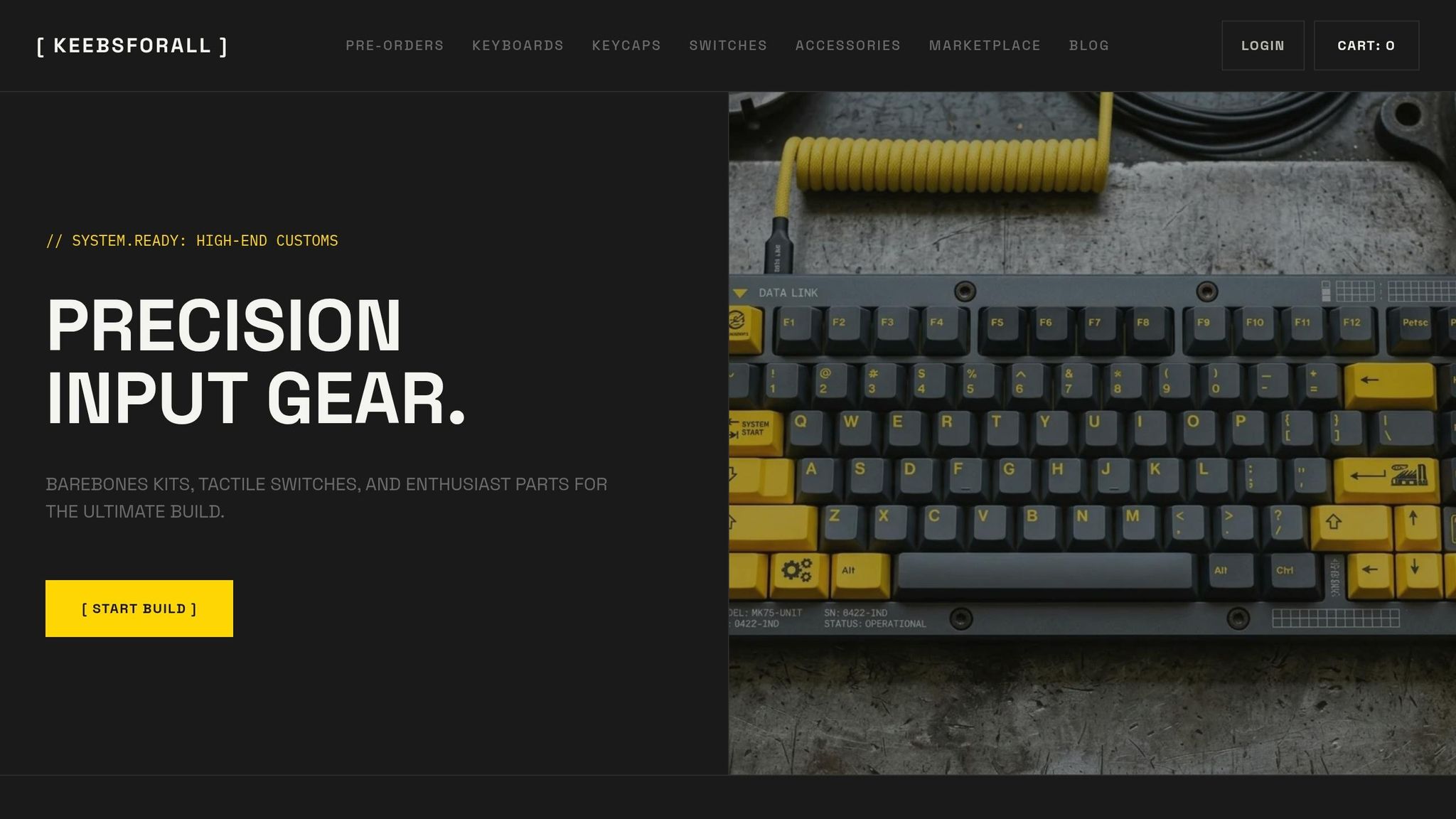
KeebsForAll focuses heavily on the in-stock model. Their Freebird series is a standout example, featuring CNC aluminum keyboards with hot-swap support and USB-C connectivity. Here’s a quick breakdown of the lineup:
- Freebird60: Starting at $160.00
- Freebird75: Starting at $199.00
- Freebird TKL: Starting at $249.99
Beyond keyboards, KeebsForAll also offers KFA-branded switches and handy tools like the KFA Switch Opener ($19.00), making it easy for builders to find everything they need in one place.
For those hunting for older or discontinued items, the KFA Marketplace at kfamarketplace.com is worth checking out. This platform allows third-party sellers to list used custom keyboards. Every item is verified by KFA staff to ensure quality, a process that typically takes 2–3 weeks. Note that a 6.5% fee is applied at checkout.
Next, we’ll take a closer look at how these purchasing models stack up against each other.
Group Buy vs. Pre-Order vs. In-Stock: A Side-by-Side Comparison
Here’s a breakdown of how these three purchasing models compare across key factors:
| Feature | Group Buy | Pre-Order | In-Stock |
|---|---|---|---|
| Product Stage | Design phase; not yet manufactured | In production or shipping to vendor | Manufactured and in warehouse |
| Payment Timing | Upfront at checkout | Upfront at checkout | Upfront at checkout |
| Wait Time | Long (months to over a year) | Moderate (weeks to months) | Minimal (days) |
| Price | Lowest | Mid-range | Highest (retail) |
| MOQ Requirement | Yes - project may be canceled if not met | No | No |
| Risk Level | High (cancellation or delays possible) | Low to moderate | Minimal |
| Returns/Cancellations | Generally not accepted | Generally not accepted | Accepted (typically within 14 days) |
| Availability | Limited-time window; often one-time only | Limited extra stock | Available until sold out |
Which Model is Right for You?
The table highlights the key differences between these options. Your decision will depend on whether you value price, speed, or exclusivity the most. Each model has its strengths and trade-offs:
-
Group buys are perfect if you're looking for the lowest price or a unique, one-time design. Keep in mind, though, that you’ll face longer waits and the risk of cancellations if the minimum order quantity (MOQ) isn’t met. As KEYGEM puts it:
"Pick a Group-Buy if you love being part of the creative process, don't mind waiting, and don't want to miss a one-time release."
- Pre-orders work well if you missed the group buy but still want to secure a unit before it’s gone. Since production is already underway, the risks are lower than group buys, though you’ll still need to wait a few weeks or months.
- In-stock purchases are the way to go if you’re new to the hobby, need your keyboard quickly, or prefer the option to return or cancel. It’s the simplest and fastest route from purchase to build, though it comes at a higher price point.
Conclusion: Picking the Right Purchasing Model
Choosing the right purchasing model means weighing price, wait time, and risk - you can usually optimize for two, but rarely all three.
- Group buys are perfect if you're after lower prices and exclusivity but don't mind waiting for months.
- Pre-orders strike a balance, offering a more predictable timeline with moderate delays.
- In-stock purchases are the go-to for those who want their items quickly and value flexibility.
One key tip: avoid combining purchasing models in a single order. For example, adding an in-stock item to a group buy or pre-order will delay the whole shipment. To get in-stock items right away, place a separate order.
Whether you're new to mechanical keyboards or planning your next custom build, understanding these models helps you make smarter decisions. Focus on what matters most to you - be it affordability, speed, or peace of mind.
FAQs
How do I know if a group buy is trustworthy?
To gauge the reliability of a group buy, start by looking into the organizer's background. Investigate their reputation, past projects, and how they communicate with participants. Make sure they’ve shared photos of actual prototypes - not just digital renders - and included thorough technical specifications. Dive into enthusiast forums to follow project threads and monitor updates. Joining the vendor's Discord server can also give you insight into how they manage customer support. Stick with vendors who have a solid history of successful projects to minimize potential risks.
Can I cancel or get a refund on a group buy or pre-order?
At KeebsForAll, once you place a pre-order, it cannot be canceled or refunded - this policy is clearly mentioned on the product pages. Additionally, pre-order items are not eligible for returns. While the policy on group buy cancellations isn’t explicitly outlined, it’s important to note that all pre-order sales are final.
If you have any questions or need help with an existing order, feel free to reach out to KeebsForAll customer service at hello@keebsforall.com. They’re there to assist you!
Should I place separate orders for in-stock and pre-order items?
If you're ordering both in-stock and pre-order items, it's a good idea to place separate orders. Why? Because if you combine them in a single order, your in-stock items will be held back until the pre-order items are ready to ship. To avoid delays and receive your in-stock items sooner, make sure to order them separately from any pre-order or group buy items.