
Are Premium Keyboards Worth It? Pros and Cons
[ Back to Mechanical Keyboards 101 ]Premium keyboards offer better build quality, durability, and a superior typing experience compared to budget options. They are ideal for heavy typists, gamers, and enthusiasts who value customization. However, they come with high upfront costs, a learning curve for beginners, and diminishing returns beyond mid-range models. Here's a quick breakdown:
Key Takeaways:
- Build Quality: Materials like CNC-machined aluminum and PBT keycaps ensure longevity and a solid feel.
- Customization: Hot-swappable switches, advanced remapping, and modular designs let users personalize their keyboards.
- Typing Feel: Gasket mounting and premium stabilizers create a smoother, quieter experience.
- Cost: Prices range from $200 to $600+, with additional expenses for keycaps, switches, and maintenance tools.
- Learning Curve: Beginners may need time to understand components, software, and assembly.
Should You Buy One?
If you type for long hours or want a tailored setup, a premium keyboard can be a worthwhile investment. But for casual users, the benefits might not justify the price.
Premium vs Budget Mechanical Keyboards: Complete Comparison Guide
Premium vs Budget Mechanical Keyboard: Why Pay More?
sbb-itb-3cb9615
What Makes a Keyboard 'Premium'?
Premium keyboards stand out thanks to their superior construction, advanced features, and exceptional typing experience. Let's break down what sets them apart.
Build Quality and Materials
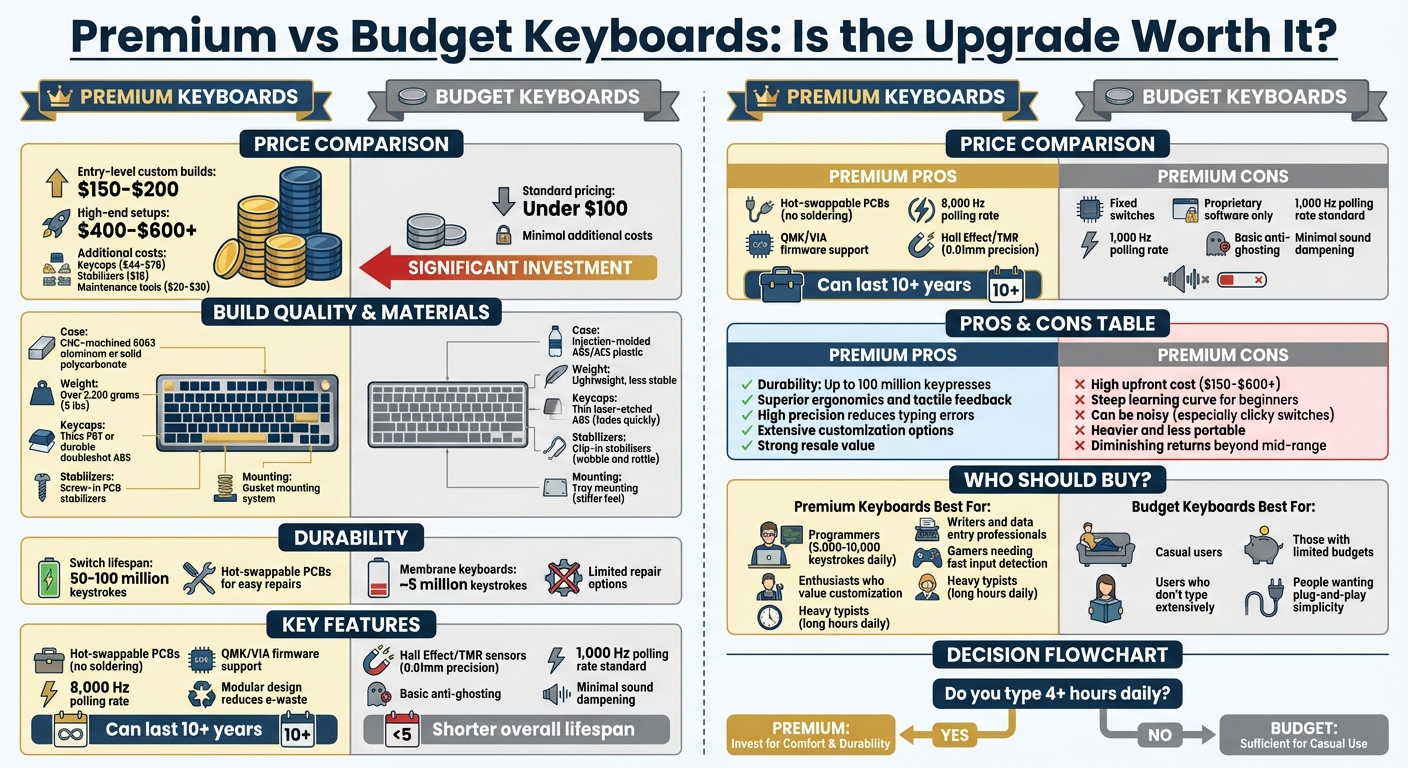
The first thing you'll notice in a premium keyboard is its build quality. These keyboards often feature cases made from CNC-machined 6063 aluminum or solid polycarbonate, weighing over 2,200 grams (about 5 lbs). This heft provides stability, keeping the keyboard firmly in place whether you're typing furiously or gaming intensely. On the other hand, budget keyboards typically rely on lightweight injection-molded ABS or AES plastic, which can feel hollow and produce unpleasant vibrations.
Keycaps also play a big role. Premium keyboards come with thick PBT keycaps or durable doubleshot ABS, which resist wear and avoid the shiny appearance caused by finger oils. Budget options, however, often include thin, laser-etched ABS keycaps that fade and wear down quickly. Another standout feature in premium keyboards is the use of screw-in PCB stabilizers, which reduce key wobble and eliminate rattling - a common issue with the clip-in stabilizers found on budget boards.
Features and Customization
Premium keyboards shine in their features and customization options. Many include hot-swappable PCBs, allowing you to swap out switches without soldering, and they often support QMK or VIA firmware for advanced key remapping and macro programming without relying on proprietary software. For gamers, some high-end keyboards boast polling rates of 8,000 Hz (8K), drastically cutting input lag compared to the standard 1,000 Hz.
Another innovation in premium models is the integration of Hall Effect or TMR sensors, which enable contactless actuation and adjustable trigger points with precision as fine as 0.01 mm. These features provide a level of control and personalization that budget keyboards simply can't match.
Typing Feel and Sound
A premium typing experience isn't just about looks and features - it's also about feel and sound. The mounting system plays a crucial role here. Premium keyboards often use gasket mounting, where foam or silicone strips cushion the plate, creating a flexible, "bouncy" typing feel and a consistent sound profile. In contrast, budget keyboards rely on tray mounting, which screws the PCB directly into the case, resulting in a stiffer and less refined typing experience.
Sound is another area where premium keyboards excel. They achieve distinct acoustic profiles - whether it's the deep, rounded "thock" or the sharp, crisp "clack" - through layers of materials like PORON foam, IXPE switch pads, and silicone gaskets. Even the plate material affects the sound: FR4 and polycarbonate plates produce softer, deeper tones, while brass and steel plates create a more rigid, higher-pitched sound. On the flip side, budget keyboards often produce hollow, plasticky noises that lack the sophistication of a well-engineered premium board.
In short, premium keyboards combine thoughtful design, high-quality materials, and advanced engineering to deliver an unparalleled typing experience.
Pros of Premium Mechanical Keyboards
Durability and Longevity
Premium mechanical keyboards are built to last. Their switches are typically rated for 50 million to 100 million keystrokes, far outpacing the lifespan of standard membrane keyboards, which average around 5 million keystrokes. This durability ensures consistent performance over years of use. Plus, their modular design allows for easy replacement of individual keys. Many models even feature hot-swappable PCBs, letting users change or upgrade switches without soldering. This not only simplifies repairs but also reduces electronic waste. For example, a developer who types 5,000 to 10,000 keystrokes daily can rely on a premium keyboard for several years before any maintenance becomes necessary.
The materials used in premium keyboards also play a critical role. Thick PBT keycaps resist the shiny wear commonly seen in cheaper ABS plastic. These keycaps are also removable, making deep cleaning straightforward and helping the keyboard maintain its appearance and functionality over time. Combined with their durable design, these features contribute to a superior typing experience that lasts.
Better Typing Experience
Premium mechanical keyboards don't just last longer - they feel better to use. They deliver a tactile and acoustic experience that elevates everyday typing. High-quality switches, refined stabilizers, and effective sound dampening work together to create a smooth, consistent feel. Whether you prefer tactile, linear, or other switch types, these keyboards maintain their performance even after millions of keystrokes.
Features like N-Key Rollover (NKRO) and anti-ghosting ensure that every keypress is accurately registered, even when multiple keys are pressed simultaneously. Additionally, internal foam and advanced mounting systems eliminate the hollow, cheap sound found in budget keyboards, providing a much more refined acoustic profile. The result? A typing experience that’s both satisfying and reliable.
Resale Value and Community Demand
Another advantage of premium mechanical keyboards is their strong resale value. Unlike most electronics, which quickly depreciate, these keyboards hold their worth exceptionally well. Their longevity, modular design, and customizable components make them appealing to secondary buyers. Interchangeable switches, keycaps, and frames allow users to personalize their keyboards, making them versatile and adaptable for multiple owners.
The active mechanical keyboard community also plays a big role in maintaining demand. Enthusiasts gather on forums, subreddits, and at meetups to discuss, trade, and sell custom keyboards. Platforms like KFA Marketplace make it easy for users to buy and sell used mechanical keyboards. Thanks to features like hot-swappable PCBs and replaceable components, a well-maintained keyboard can serve multiple owners over a lifespan of a decade or more. This makes investing in a premium mechanical keyboard not just a practical choice but also a financially sound one.
Cons of Premium Mechanical Keyboards
High Upfront Cost
One of the biggest hurdles to owning a premium mechanical keyboard is the hefty price tag. These keyboards come with a steep upfront cost, which can be daunting for newcomers. Entry-level custom builds typically start at around $150 to $200, while high-end setups can easily climb to $400, $600, or even more. The price adds up quickly because you're not just buying a single product - you're investing in individual components that collectively drive up the total.
The cost is largely driven by the use of high-quality materials, limited production runs, and boutique components. Unlike budget keyboards made from ABS plastic, premium keyboards often feature cases crafted from CNC-machined aluminum, stainless steel, or brass. Many of these keyboards are produced in small batches or through "Group Buys", where limited runs result in higher per-unit prices. These factors make the hobby expensive and can be a significant barrier for beginners.
Learning Curve for Beginners
Premium mechanical keyboards aren’t as simple as plug-and-play. They require a level of technical knowledge and effort that can feel overwhelming for first-timers. Beginners often face a steep learning curve, navigating dense forums, unfamiliar acronyms, and detailed tutorials. To get started, you’ll need to understand key aspects like PCB types, plate materials (brass, aluminum, or carbon fiber), mounting styles (such as gasket or tray mount), and the differences between linear, tactile, and clicky switches.
Compatibility can also be a headache. Since there aren't many universal manufacturing standards, parts from different brands might not fit together seamlessly, potentially leading to wasted money. Some premium keyboards require soldering skills and specialized tools, although hot-swappable boards offer a more beginner-friendly option. On top of that, customizing layouts and macros often involves using open-source software like VIA, which has its own learning curve.
"Because the hobby is driven mostly by small and local manufacturers... waiting months or even a year for a part to arrive is not uncommon".
If you want that premium feel, you'll also need to dedicate time to tasks like manually lubing each switch and stabilizer. While the process can be rewarding, it’s time-intensive and adds to the complexity. For many, the effort doesn't always feel proportional to the performance improvements.
Diminishing Returns
When it comes to performance, the leap from a $150 keyboard to a $500 one is surprisingly small. The most noticeable upgrade happens when switching from a membrane keyboard to any mechanical keyboard. Beyond that, the jump to premium models often offers only minor improvements. Much of the added cost is tied to niche features like specific acoustic profiles (those "thocky" or "clacky" sounds), aesthetic customizations, and exclusivity, rather than tangible benefits like faster typing or better accuracy.
For most users, the difference between mid-range and premium keyboards is marginal. A budget mechanical keyboard might have a plastic case that feels less refined, but it still delivers the core mechanical experience. Unless you’re typing thousands of words every day, the incremental gains in feel and sound may not justify the significantly higher price.
Is a Premium Keyboard Right for You?
Deciding whether to invest in a premium keyboard comes down to your specific needs, how much you're willing to spend, and whether customization appeals to you. It's all about finding the right balance between features, functionality, and cost.
Identify Your Use Case
Your intended use plays a big role in choosing the right keyboard. For example:
- Programmers might benefit from advanced features like QMK/VIA remapping. These tools let you reassign keys - turning CapsLock into a "Super" or "Fn" key - and create custom layers to reduce repetitive keystrokes. If speed is critical, consider keyboards with Hall Effect switches, such as the Gateron Magnetic Orange, priced at $0.71 per switch. These switches are faster and more responsive than standard mechanical options.
- Gamers often need lightning-fast input detection, making premium switches a worthwhile investment.
- Writers and data entry professionals should prioritize comfort and customization. Whether you prefer linear or tactile switches, a hot-swappable PCB can be a game-changer. It allows you to experiment with switch types without soldering, so you can fine-tune your keyboard to match your preferences.
Your use case will guide how much you should spend and what features to prioritize.
Set Your Budget
When budgeting, think beyond the keyboard itself. For instance:
- A Freebird60 Full Kit starts at $160.00, while the Freebird75 is $199.00, and the Freebird TKL costs $249.99.
- Premium keycap sets range from $44.00 to $78.00.
- High-quality stabilizers, like AEBoards Staebies V2.1, are about $18.00.
- Maintenance tools, including switch pullers, lube brushes, and Krytox 205g0 lubricant, can add $20 to $30 to your expenses.
If you're considering Group Buys, keep in mind they often offer lower prices but come with long waiting periods. On the other hand, in-stock items are more expensive but ship immediately. If you need a keyboard quickly, plan for the higher costs of in-stock options.
Being realistic about your budget helps you make smarter choices and ensures you get the most value for your money.
Consider a Gradual Upgrade Path
Premium keyboards are built to last, which makes them ideal for gradual upgrades. Start with a solid base, like the Freebird series, which features a hot-swappable PCB and a CNC-machined aluminum case. Begin with affordable switches (some as low as $0.30 each) and basic keycaps, then upgrade components over time as your needs and budget allow.
This modular approach lets you spread out costs while refining your setup. For instance, you can upgrade to premium switches, stabilizers, or keycaps later. The KFA Marketplace is a great resource for finding pre-owned high-end components at a variety of price points.
Conclusion: Weighing the Pros and Cons
Premium mechanical keyboards stand out for their durability, precise typing experience, and customization potential. But they also come with a hefty price tag and can be noisier than standard options. The key is deciding whether their unique benefits match your needs and budget.
Pros and Cons Comparison Table
Here’s a quick look at the main advantages and drawbacks:
| Pros | Cons |
|---|---|
| Durability: Designed to handle up to 100 million keypresses | Cost: Noticeably more expensive than standard keyboards |
| Ergonomics: Better tactile feedback and comfort for long typing sessions | Noise: Can be loud, especially with clicky switches |
| Precision: Helps reduce typing mistakes and boosts speed | Portability: Heavier and bulkier compared to membrane keyboards |
| Customization: Swap switches and keycaps to suit your preferences | Adjustment Period: May take time to adapt to new switch types and weights |
Final Thoughts
When deciding, think about how you’ll use the keyboard daily. If you’re a heavy user - like a programmer or writer - the improved precision, comfort, and longevity might make the higher cost worthwhile. As technology writer Jennifer Allen observes, mechanical keyboards "can make a massive difference to productivity levels for programmers and people who type a lot".
For casual users, however, a standard keyboard might be the better choice. Premium options shine when their features solve real problems in your current setup. And since many mechanical keyboards are built to last over a decade, the upfront cost becomes more reasonable when spread across years of use. If you choose to invest, start with a reliable mechanical keyboard and upgrade parts like switches and keycaps over time as your preferences evolve.
FAQs
What sets premium keyboards apart from budget ones?
Premium keyboards excel in three key areas: build quality, switch performance, and features. These keyboards are often crafted with durable materials like aluminum or brass for their cases, paired with high-quality PCBs and top-tier keycaps, such as double-shot PBT. These keycaps not only feel solid but are also resistant to wear and tear. In contrast, budget keyboards usually feature plastic cases and ABS keycaps, which can feel less durable and tend to develop a glossy finish over time. The result? Premium keyboards provide a heavier, more stable typing experience that's hard to match.
Switch performance is another major factor. Premium keyboards typically come equipped with high-end mechanical switches designed for smoother, more consistent keystrokes and extended durability. On the flip side, budget keyboards often use entry-level switches, which may feel less polished and wear down faster, ultimately affecting both the typing experience and sound quality.
When it comes to features, premium keyboards truly shine. They often include perks like customizable RGB lighting, hot-swappable switches, and programmable key mapping. Budget keyboards, meanwhile, tend to stick with basic layouts and limited functionality. This makes premium options a better fit for gaming, programming, or ergonomic setups where versatility and customization are key.
Are premium mechanical keyboards worth the cost?
Deciding whether a premium mechanical keyboard is worth the investment comes down to your personal needs and preferences. These keyboards often boast durable materials like PBT keycaps, sturdy metal frames, and advanced switches. They also come with extras such as hot-swappable sockets, RGB lighting, and programmable options. These features not only improve durability but also enhance typing comfort and allow for a high degree of customization - perfect for avid typists, gamers, or those who enjoy tweaking their setup.
Consider your usage: Do you spend hours typing every day? Are features like fast switch responsiveness or a detachable wrist rest important to you? Do you enjoy personalizing your gear? If the answer to these questions is yes, upgrading to a premium keyboard could be a solid choice. On the other hand, if you're content with basic functionality, a thoughtfully chosen budget keyboard can still deliver excellent performance.
Another point to keep in mind: premium keyboards often retain their value well. If you decide to upgrade later, platforms like KeebsForAll’s second-hand marketplace make it easy to resell or even buy pre-assembled custom keyboards, which can help offset the upfront cost. Ultimately, the key is determining whether the improved build quality and extra features will make a noticeable difference in your daily routine.
What can you customize on a premium mechanical keyboard?
Premium mechanical keyboards give you the freedom to tailor your typing experience to your liking, from how they feel and sound to how they look. One of the first choices you'll make is selecting the switches - linear, tactile, or clicky - each offering its own distinct sensation and feedback. Many high-end keyboards also come with hot-swappable PCBs, meaning you can change out switches without any soldering involved.
The customization doesn’t stop there. Keycaps come in a range of materials, shapes, and colors, letting you design a keyboard that’s uniquely yours. You can also experiment with different plates, like aluminum or polycarbonate, to tweak the keyboard's sound and rigidity. Even the case material and design can be chosen to fit your style or ergonomic preferences.
On the tech side, premium keyboards often support software customization. This includes features like per-key RGB lighting, programmable macros, and key remapping, typically managed through firmware such as QMK or VIA. For the truly dedicated, lubing switches and stabilizers can take the typing experience to the next level, making keystrokes smoother and quieter. All of these options make premium keyboards the ultimate tool for creating a personalized setup.